Regional Center vendors in CA: what studios should know
ORYN Team8 min read
Southern California

To become a regional center vendor in California, a studio applies online through DDS's online vendor application system; the regional center for the area where the studio is located reviews it, and if approved assigns a vendor number and a service code. Regional centers pay rates set through DDS's rate system for each service code, which may differ from your posted tuition.
1. What vendorization actually means for a kids' activity business
California's 21 regional centers coordinate services for people with developmental disabilities under the Department of Developmental Services (DDS). When a family wants your adaptive ballet class, swim lesson, or music session paid for through their child's regional center, the center needs you on its approved list. That process is called vendorization, and it is how a class business becomes an authorized vendor whose services the center can purchase.
Two things surprise most studio owners. First, vendorization is not a stamp of approval on your whole business. You are vendored for a specific service code, so a center might approve you for an adaptive group class but not for private lessons. Second, regional centers pay rates set through DDS's rate system for each service code, which may differ from your posted tuition; ask the center which rate applies to your code. That shapes whether vendorization makes financial sense for you, and we cover the money side in section 4.
It also works differently from parent-paid enrollment in small ways that matter operationally. The center, not the family, is your payer. Authorizations come with start dates, end dates, and unit limits. You will submit claims or attendance records to the center, and payment follows the center's cycle rather than your monthly billing.
2. Which Los Angeles-area regional centers to approach
Seven regional centers serve parts of Los Angeles County:
- South Central Los Angeles Regional Center (SCLARC)
- Eastern Los Angeles Regional Center (ELARC)
- Frank D. Lanterman Regional Center, covering much of central LA
- North Los Angeles County Regional Center (NLACRC), including the Antelope Valley
- San Gabriel/Pomona Regional Center (SGPRC)
- Harbor Regional Center, serving the South Bay
- Westside Regional Center, covering the west side of LA
Here is the part that trips people up: the family's address, not your studio's marketing area, decides which center handles their case. A Glendale studio might serve families whose cases sit with Lanterman, NLACRC, or San Gabriel/Pomona. Your application, though, goes to the center where your studio is (DDS calls it the vendoring regional center). Ask it how families from other centers' areas can use your service.
A practical first step: ask the families already in your classes which center coordinates their child's services. Two or three inquiries from existing families is a much stronger reason to apply to a given center than a cold pitch, because center staff often ask whether there is current demand for your service in their area.
3. The vendorization application step by step
The exact forms vary a little by center, but the bones are the same everywhere, following the vendorization rules in Title 17 of the California Code of Regulations and DDS policy. Confirm current requirements and timelines directly with your center, because they change and processing times vary.
Step 1: Find your vendoring regional center and start online. Find your vendoring regional center with DDS's regional center lookup (enter your business address), then start the application in DDS's online vendor application system. Tell the center the service you want vendored (for example, adaptive gymnastics instruction or social skills movement classes) and ask which service code fits it.
Step 2: Gather your documents. Documents the center may ask for include your business license, proof of insurance, qualifications for anyone delivering the service, a description of the class, your rates, and staff resumes or certifications. Some centers want lesson plans or a sample session outline so they can match your service to a code.
Step 3: Live Scan. Expect a fingerprint background check (Live Scan) for staff who work directly with the children; ask your center what it requires and who receives the results. The California Department of Justice explains the Live Scan process. Budget for the rolling fee plus the DOJ and FBI processing fees per person.
Step 4: Assignment of a service code and vendor number. The center reviews your application, confirms the code, and if approved issues a vendor number. Only after this can a center authorize families to use your service.
Step 5: Ask about similar services. Ask the center whether similar services are already vendored in its area. If several adaptive dance vendors already serve it, you will want a clear answer for why yours is needed.
Step 6: Set up billing. Ask the center which billing or claims process it uses and what documentation each claim needs, because incomplete attendance records are a common reason payments lag.
4. Service codes and rates: how much regional centers pay for classes
This is where studio owners do the real math. Regional centers pay rates set through DDS's rate system for each service code, which may differ from your posted tuition; ask the center which rate applies to your code.
The only way to know how a center rate compares with your own prices is to ask the center for the current rate for the specific code you are applying under, then compare it against your standard tuition before deciding how many seats to allocate. Some studios dedicate a fixed number of seats to center-funded families and keep the rest parent-paid, which brings the budgets into balance.
Also ask about units. Codes are typically paid per session or per month, with caps on how many units a family can be authorized per year. A monthly cap of four sessions fits a weekly class cleanly; a cap of six does not.
5. Timeline, renewals, and common reasons applications stall
Do not count on a fixed timeline. Application review, Live Scan results, and internal sign-offs each take their own time, and centers differ. Ask the center for its current estimate when you apply, and check in if you have heard nothing.
Applications stall for predictable reasons:
- No demonstrated demand. Centers prioritize services families are actually asking for. Letters or calls from two or three families carry real weight.
- Missing staff documentation. Expect the center to ask for current certifications and a cleared background check for each instructor who works directly with the children.
- Ambiguous service description. If your class description could match three different codes, the review slows down while staff decide. Name the closest existing code in your area when you submit.
- Insurance gaps. Your certificate must match the center's requirements for coverage type and limits.
- Duplicate service. If similar services are already vendored nearby, expect questions about why another is needed.
Once vendored, keep your file current. New staff, a move, or a change in class structure usually requires an update to the center, and an out-of-date file can pause authorizations.
6. Filling the seats regional center funding doesn't cover
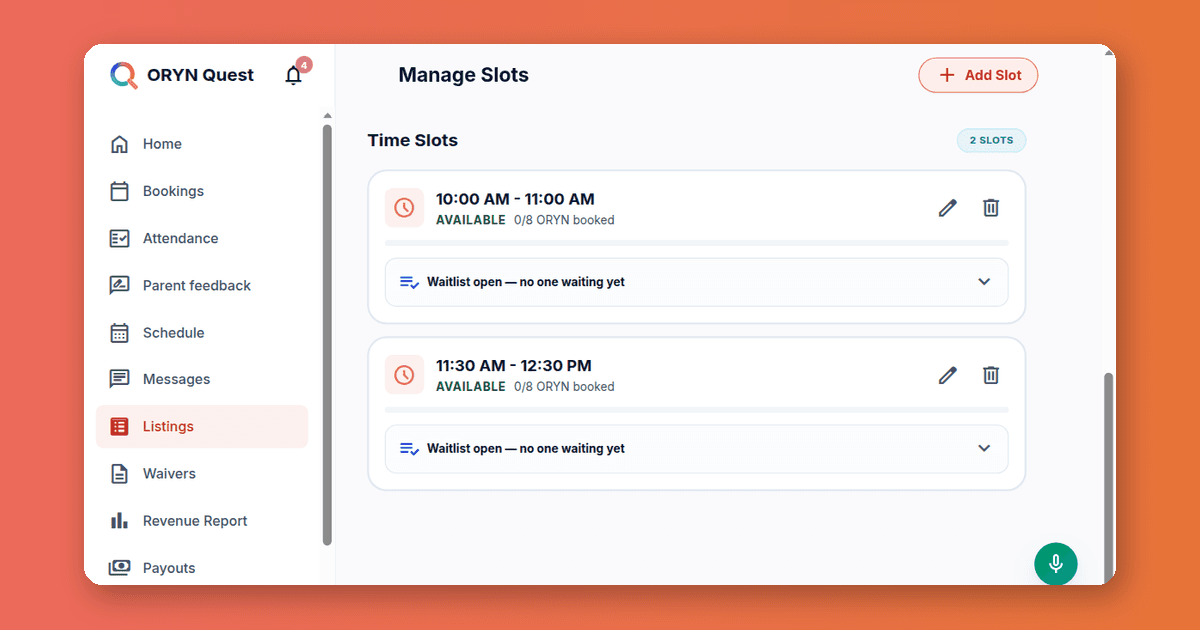
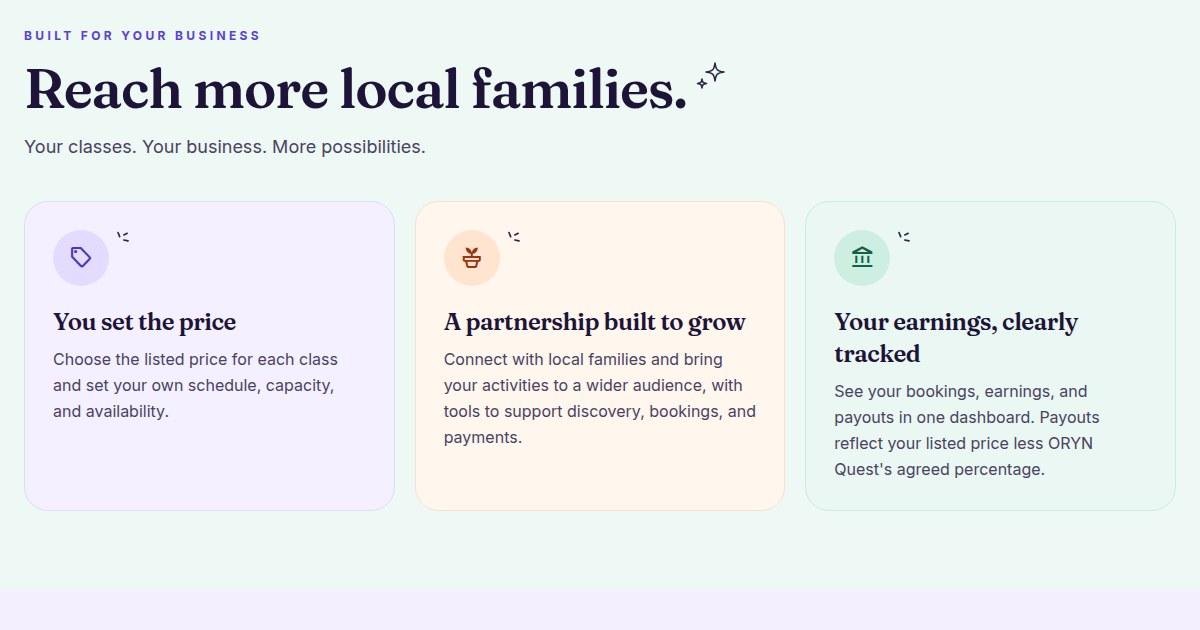
Vendorization covers a slice of your enrollment. The rest of your seats still need local families finding you, and that is a different job. ORYN Quest is a marketplace where families book kids' activities that independent local businesses run. Applying, listing classes, and every vendor tool are free at orynquest.com/vendor-apply, and the seven-step application saves your progress so you can finish later on any device. When families book, ORYN Quest retains an agreed percentage of the listed class price to support discovery, bookings, and payments. Payouts run monthly through Stripe for sessions at least 14 days old, once $50 or more is due. You keep ownership of your photos and brand, and the service area today is Southern California (ZIP codes 900 through 935). A vendor can also offer a last-minute deal of 5 to 75% off sessions starting within 24 hours that still have seats, and ORYN pays the discount.
If you are weighing how a center rate compares to your posted tuition, the pricing method for studio owners walks through a simple cost-per-seat calculation, and filling last-minute open spots covers the same-day deal mechanics. You can read more about joining ORYN Quest as a vendor and how ORYN Quest treats vendor verification. To be clear on that last point: approval on ORYN Quest is not a license check, inspection, insurance audit, background check or endorsement, ORYN does not insure vendors, and each vendor screens its own staff. Vendorization through a regional center is a process you handle directly with the center.
Ready to line up the parent-paid side of your schedule? Start your free application at orynquest.com/vendor-apply.
Run a kids' activity business? See how ORYN Quest works for vendors.
Questions vendors ask
- How much does a regional center pay vendors?
Regional centers pay rates set through DDS's rate system for each service code, which may differ from your posted tuition. Rates vary by code, so ask the center which rate applies to your code and compare it against your standard monthly price before committing seats.
- How do I become a vendor for a regional center?
Apply online through DDS's online vendor application system. Your application is reviewed by the vendoring regional center, the center for the area where your studio is located. Expect to show your business documents and staff qualifications, expect a Live Scan background check for staff who work directly with the children, and if approved you receive a service code and vendor number. Confirm current requirements and timelines with the center.
- Can anyone be vendored by a regional center?
Any legitimate business, instructor, or non-profit can apply, but approval is not automatic. The center checks the service, your qualifications for the specific service code, staff clearances, and insurance.
- Can a vendor serve only one regional center's area?
Families across several catchment areas may attend one studio, but your application is reviewed by the center where your studio is located. Ask that center how families from other centers' areas can use your service.
Get ORYN news by email
An occasional email about new classes and events. We'll send a link to confirm first.
Every email has a one-click unsubscribe link.
About ORYN Quest. ORYN Quest is a credit-based marketplace for children's activities: parents pick a monthly plan and book real classes and lessons from local vendors. Vendor earnings and any fees follow the applicable participation agreement and fee schedule. Southern California today. Questions: support@orynquest.com.